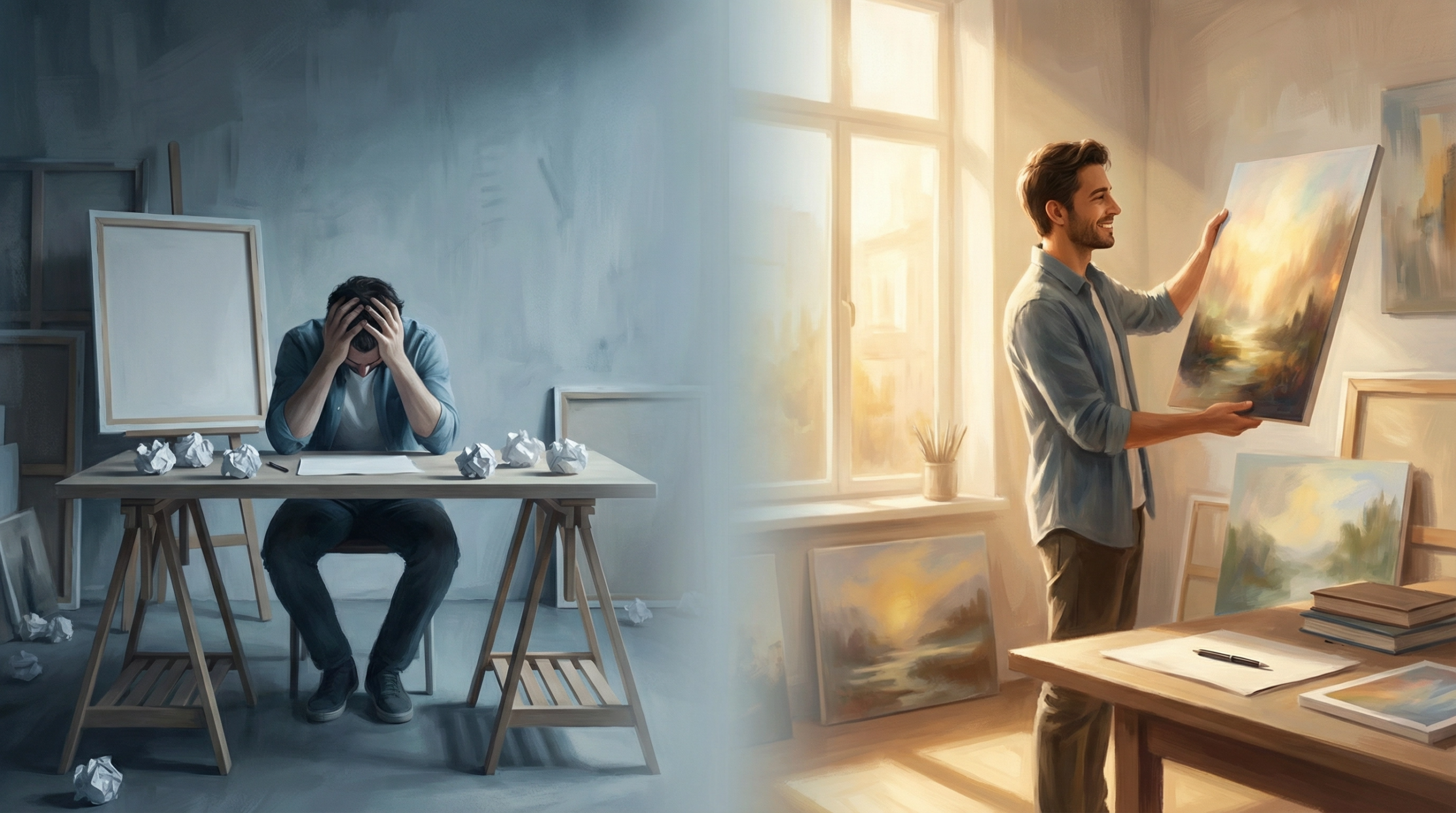
You know that feeling when you sit down to create something, and suddenly your brain just… freezes? Maybe you’re staring at a blank canvas, or your cursor is blinking on an empty page, or you’re looking at your design software wondering where to even start. Your heart races a little. Your stomach feels tight. You have all these amazing ideas swirling around in your head, but the moment you try to bring them into the real world, everything grinds to a halt.
If this sounds familiar, you’re definitely not alone. At Growth and Healing Wellness Center, Margie Mader, LMFT, CHT, works with creative people every single day who struggle with this exact problem. It’s called performance anxiety, and it affects artists, writers, designers, and all kinds of creative folks. The good news? There are real, practical tools that can help you break through that paralysis and actually finish your work.
What Performance Anxiety Looks Like for Creatives
Performance anxiety isn’t just about getting nervous before giving a speech or playing a concert. For creative people, it shows up in sneaky ways that can completely derail your projects.
Maybe you spend hours “researching” or “gathering inspiration” instead of actually starting. Maybe you begin ten different projects but never finish any of them. Maybe you convince yourself that your idea isn’t good enough, so you abandon it before giving it a real chance. Or maybe you do create something, but then you’re too scared to share it with anyone.
This isn’t laziness or lack of talent. It’s your brain trying to protect you from the vulnerable feeling of putting your work out into the world. Your creative work is personal. It comes from inside you. So when you imagine someone judging it or not liking it, it can feel like they’re judging YOU.
Why Traditional Advice Doesn’t Always Work
You’ve probably heard the usual advice: “Just do it!” or “Stop overthinking!” or “Believe in yourself!” And while those things sound nice, they don’t really give you a roadmap for what to do when you’re stuck.
A lot of performance advice out there is designed for corporate settings or traditional performers. But creatives face different challenges. You’re not just executing someone else’s vision or following a script. You’re pulling ideas out of thin air and turning them into something real. That’s a completely different kind of pressure.
That’s why Margie Mader focuses on project-scoped remedies—practical strategies that you can apply to the specific creative project you’re working on right now.
Deadline Slicing: Breaking the Overwhelm
One of the most powerful tools in the creative anxiety toolkit is something called deadline slicing. Here’s how it works.
Instead of having one big, scary deadline for your entire project, you slice it up into much smaller pieces with their own mini-deadlines. And we’re talking REALLY small pieces.
Let’s say you’re writing a short story. Instead of telling yourself “I need to finish this story by next month,” you might slice it like this:
- Monday: Write the opening scene (just 200 words)
- Wednesday: Introduce the main character’s problem
- Friday: Write the confrontation scene
- Next Monday: Write the resolution
- Next Wednesday: Edit the first half
- Next Friday: Edit the second half and format
See the difference? Each piece feels manageable. You’re not trying to climb the whole mountain at once. You’re just taking the next step.
This works because our brains handle small tasks much better than huge ones. When you look at a massive project, your anxiety spikes. But when you look at a tiny, specific task, your brain thinks, “Okay, I can do that.”
The key is making your slices small enough that they don’t trigger that freeze response. If a slice still feels too big, slice it smaller. There’s no such thing as too small when you’re building momentum.
Public Accountability Formats That Actually Help
Another game-changing strategy is using public accountability—but in a way that supports your creative process instead of adding more pressure.
Traditional accountability can backfire for creatives. If you announce “I’m going to finish my novel this year!” to everyone you know, that can actually increase your anxiety. Now you’re not just worried about the work itself—you’re worried about looking like a failure if you don’t meet that big goal.
Instead, try these creative-friendly accountability formats:
Progress Sharing: Instead of announcing your end goal, share your process. Post a photo of your workspace. Share one sentence you wrote today. Show a tiny sketch. This takes the pressure off the final product and celebrates the act of showing up.
Accountability Partners: Find one or two other creatives who get it. Check in with each other weekly (or even daily) about what small step you’re taking next. The key is keeping it judgment-free and focused on action, not results.
Time-Based Commitments: Instead of committing to finish something, commit to spending time on it. “I’m going to work on my design project for 30 minutes today” is much less scary than “I’m going to finish this design today.”
Celebration Check-Ins: Create a system where you share what you DID, not what you didn’t do. Every small win counts. Opened the file? That’s a win. Wrote one paragraph? That’s a win. Mixed one color? That’s a win.
Moving From Paralysis to Action
The path from idea paralysis to finished work isn’t about becoming fearless. It’s about learning to work alongside your fear instead of waiting for it to disappear.
Margie Mader helps creatives understand that anxiety is information, not a stop sign. When you feel that freeze response, it’s your brain saying “This matters to me.” That’s actually a good thing. It means you care about your work.
The toolkit approach means you don’t have to fix your anxiety before you can create. You just need strategies that help you take action even when anxiety is present.
Start with one project. Pick something small—not your magnum opus, just something you’d like to finish. Try deadline slicing. Break it into ridiculously small pieces. Then add one form of accountability that feels supportive, not scary.
You might be surprised at how much easier it becomes to move forward when you’re not trying to do everything at once.
Your Creative Work Matters
At Growth and Healing Wellness Center, the belief is simple: your creative work deserves to exist in the world. Not someday when you’re “good enough” or “ready enough.” Right now, exactly as you are.
Performance anxiety might never completely disappear, and that’s okay. You can still create meaningful work. You can still finish projects. You can still share your gifts with the world.
The toolkit is here. The strategies work. And you don’t have to figure it all out alone.
If you’re ready to move from idea paralysis to finished work, these project-scoped remedies can help you get there—one small, manageable slice at a time.
Margie Mader, LMFT, CHT, at Growth and Healing Wellness Center specializes in helping creatives overcome performance anxiety and bring their projects to life. Because the world needs what you’re here to create.