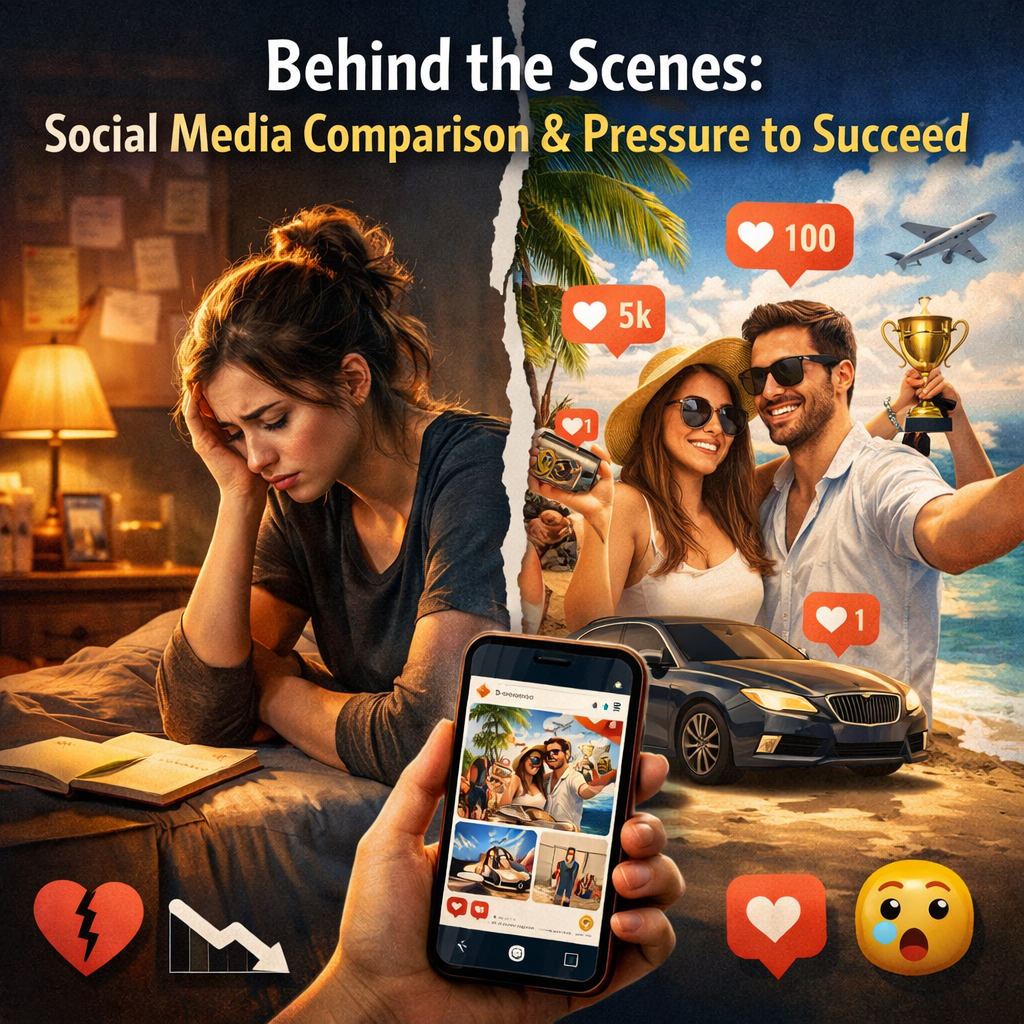
Have you ever scrolled through social media, like Instagram or TikTok, and suddenly felt like your life wasn’t good enough? Maybe you saw someone’s perfect vacation photos, their new car, or their amazing grades, and thought, “Why can’t I have that?” If so, you’re not alone. Millions of people feel this way every single day, and there’s actually a scientific reason why it happens.
I’m Margie Mader, a Licensed Marriage and Family Therapist and Certified Hypnotherapist at Growth and Healing Wellness Center. I’ve worked with countless teens and adults who struggle with the pressure that comes from comparing themselves to others online. Today, I want to pull back the curtain and show you exactly how social media tricks your brain into feeling “less than” — and more importantly, what you can actually do about it.
The Comparison Loop: How Your Brain Gets Trapped
Let’s start by understanding what’s really happening when you scroll through your feed. Social media platforms are designed — yes, actually designed on purpose — to keep you hooked. They use something called “behavioral triggers” that tap into how your brain naturally works.
Here’s what happens: You open an app, and within seconds, you see someone living what looks like a perfect life. Your brain immediately starts comparing. “They’re prettier than me.” “They have more friends.” “Their family seems so happy.” This comparison triggers a stress response in your body. You might feel your chest tighten or your mood drop.
But here’s the sneaky part — instead of closing the app, you keep scrolling. Why? Because your brain is hoping to find something that makes you feel better. Maybe you’ll find a post that makes you laugh, or maybe you’ll see someone who’s struggling too. This creates what psychologists call a “comparison loop.” You feel bad, so you scroll more, which makes you see more perfect-looking lives, which makes you feel worse, so you scroll even more. It’s like being on a hamster wheel that never stops.
The pressure to succeed gets worse because social media only shows highlight reels. Nobody posts about the fight they had with their mom that morning or the test they failed. They post the good stuff — the wins, the smiles, the achievements. Your brain knows this logically, but emotionally, it still feels like everyone else has it all figured out except you.
Content Diet: Taking Control of What You Consume
Now that you understand how the comparison loop works, let’s talk about something most people never consider: your content diet. Just like the food you eat affects your physical health, the content you consume affects your mental health.
Think about it this way — if you ate junk food for every meal, you’d feel terrible, right? The same thing happens when you fill your social media feed with content that makes you feel inadequate, anxious, or pressured.
Here’s your action plan for creating a healthier content diet:
What to Unfollow or Mute:
- Accounts that make you feel bad about your appearance, achievements, or lifestyle
- People who constantly brag or only post “perfect” moments
- Influencers who promote unrealistic standards (perfect bodies, expensive lifestyles, etc.)
- Anyone whose content leaves you feeling anxious, jealous, or “less than”
- Accounts that trigger specific insecurities you have
What to Follow Instead:
- Creators who share real, unfiltered moments (the messy stuff, not just the wins)
- Educational accounts that teach you something useful
- People who inspire you without making you feel inadequate
- Accounts focused on your actual hobbies and interests (not just lifestyle content)
- Mental health advocates who normalize struggles and growth
- Friends and family who post authentically
Feed Curation Template:
Create a balanced feed using this ratio:
- 40% Educational/Informative content (learn something new)
- 30% Inspirational content (motivates without triggering comparison)
- 20% Entertainment (makes you laugh or smile)
- 10% Personal connections (real friends and family)
Here’s a practical exercise: Go through your following list right now. For each account, ask yourself: “Does this make me feel better or worse about myself?” If the answer is “worse,” hit that unfollow button. You don’t owe anyone your mental health.
Remember, curating your feed isn’t mean or selfish. It’s self-care. You’re creating a digital environment that supports your growth instead of tearing you down.
A 30-Day Digital Detox: Your Step-by-Step Plan
Okay, so you’ve cleaned up your feed. Now what? This is where most advice stops — “just limit your screen time!” But that’s not enough. You need a real plan with real steps. That’s why I’ve created this 30-day scaffold to help you reset your relationship with social media.
Week 1: Awareness
- Track your screen time daily (don’t change anything yet, just notice)
- Journal prompt: “When do I reach for my phone? What am I feeling in those moments?”
- Set up app time limits (but don’t enforce them yet — just let them notify you)
- Journal prompt: “Which apps do I use most? How do I feel after using them?”
Week 2: Boundaries
- Remove social media apps from your home screen (keep them, just make them harder to access)
- Create “phone-free zones” (bedroom, dinner table, bathroom)
- Journal prompt: “What am I afraid will happen if I’m not constantly checking my phone?”
- Turn off all non-essential notifications
- Journal prompt: “What did I do with the extra time when I wasn’t checking notifications?”
Week 3: Replacement
- For every hour you reduce social media, add a real-world activity (reading, walking, calling a friend)
- Journal prompt: “What activities make me feel genuinely good about myself?”
- Practice the “10-minute rule” (when you want to scroll, wait 10 minutes and do something else first)
- Journal prompt: “Did I still want to scroll after 10 minutes? What did I do instead?”
Week 4: Integration
- Create your permanent social media schedule (example: only check twice daily for 20 minutes each)
- Journal prompt: “How has my mood changed over the past month?”
- Identify your triggers (boredom, loneliness, anxiety) and create alternative responses
- Journal prompt: “What have I learned about myself and my relationship with social media?”
Bonus Tips for Success:
- Tell a friend or family member about your plan (accountability helps!)
- Celebrate small wins (even reducing screen time by 15 minutes is progress)
- Be gentle with yourself when you slip up (this is a practice, not perfection)
- Use your phone’s grayscale mode to make apps less appealing
Moving Forward: You’re Enough Right Now
Here’s the truth that social media doesn’t want you to know: You are enough exactly as you are right now. Your worth isn’t determined by likes, followers, or how your life compares to someone else’s carefully edited highlight reel.
The pressure to succeed is real, and social media amplifies it in ways that previous generations never experienced. But you have more power than you think. By understanding how comparison loops work, curating a healthier content diet, and following a structured plan to reset your relationship with social media, you can break free from the constant pressure.
At Growth and Healing Wellness Center, I work with people every day who are reclaiming their mental health from the grip of social media comparison. It’s not about deleting all your apps or going completely offline (unless you want to). It’s about creating a balanced, intentional relationship with technology that serves you instead of draining you.
Remember: The goal isn’t to have a perfect life. The goal is to live YOUR life — messy, imperfect, and beautifully real. And that starts with taking control of what you allow into your mind and heart every day.
You’ve got this. And if you need support along the way, that’s what we’re here for.
— Margie Mader, LMFT, CHT
Growth and Healing Wellness Center